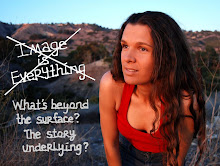
0. Ever since I applied to the AAAS Mass Media Fellowship, I feel that I have acquired heightened consciousness and that my writing has improved... to some degree.
1.In the Questioning of Reality, my profession is to extract the best out of everybody and everything, and discard all things that are negative and broken, saving them for another day for a deeper transformation into light.
2. I need to wake up every single day and see something new. Even if I have to work hard and write to see it. Even if it takes blood and sweat and tears from connecting fragmented neurons of the deep… for me to see it. For me to see something new….
3. The only person who can change me is my own self.
4. The more I learn about the environment and interactions with the environment, the more I learn about the innerworkings of my own mind.
5. To Know More? To Know Less? But don’t Know Too Much, for I have learned in several occasions it leads Down the Road to Disappointment.
6. I just wrote “Fruiel” out of me (fake name for protection). I am no longer in pain…. The experiences are in me; the person is out of me. If you know what I mean. It’s a very writerly psychological trick.
7. It’s amazing to think I have been through so much torment the last three years and to only think that I have only consciously received two gray hairs is close to biologically daunting!
8. The best part about October 15, 2005 is that you will never know the future. You will never know the consequences of your own actions. Nothing is predictable. It’s blank slate all over again, carving a road, and living twice. Seeing new elements of your environment you have never seen before… every single day is a brand new adventure of altered inner perception.
9. When you don’t consider the outcome of the future, you stop thinking about “what is the next big break” of external forces. But you think about the internal forces; you think about and tend to the community of people who have come to accept and love you… and have made a home for you. You are tending to them through your writing. The rest of “greatness” is an illusion; it’s a fun game to pursue, but meaningless beyond your own very close intellectual kin… except perhaps, to greet new members of your intimate audience. In the end of the day, all you do is care about the people who care about you.
10. My aunt Jeri Lyn thoughtfully said over Christmas, “To be an artist, you must be bold and brave to be alone. To venture into the vulnerable reaches of your seemingly tough, yet fragile mind. To sort out the deep-rooted tangles. I have Dr. Seuss’ The Lorax by my side. A children’s book that changed the world. If he can dig through himself, then so can I!
11. It’s all about the deeper motives… the deeper motives in your own hands. It’s not about the Biologically Incorrect Blog. It’s about the Lulu.
12. POEM CALLED INTELLECTUAL POTPOURRI
So I met those two lovers Of intellectual potpourri They had great big bowers Colored, playful rivalry
Certified geniuses All stood back and stared and gawked Their teasing thoughts meaningless Rehashing what is for what it ought—
To be changed.
The sincerity of problems Of our day.
Oh so silly!
The Sanctified Science of Potpourri! Society exalts Egoes Of Arbitrary To pseudo-subgod Higher Beings
For the Intellectual Entertainment Of the Long Hours of Tonight Just to relish and forget In the long, long minutes Of long lines
Of stores distracting With groceries.
*Spit!*
13. POEM CALLED ECOLOGICAL RATIONALITY VERSUS EVOLUTIONARY PRIMALITY
If the world were less populated, I would be easily satisfied with The pre-existing protocols of biology— Forage for a male and give birth to new human flesh— The usual mindless routine of evolution.
But the world is not that way today, And there is pressing value For the birth of New Ideas As opposed to the birth of empty-minded human biomass, To which merely serves as a draining resource Than a bountiful agent of thoughtful change.
And though evolution guides my thoughts toward The Commonplace of Ingrained Biological Institutions, My Ecological Rationality Trumps the Reptile And it manipulates that lizard in me Towards its very own goals….
In hope of finding all those Who do and share and pursue the same.
Sage Cat-Kat. How can a creature so miniscule be so all-encompassing? Be so profound?
I am still pissed off that I received a National Photo Award for an image of a snobbish and horribly abnoxious cat (who potentially resides in Orange County) (please visit http://www.nationalphotoawards.com/).
The Above Image is the best image I have ever taken of a cat. In fact, it is perhaps one of the best images I have ever taken in my entire life.
I have been anticipating on writing an essay on The Immensely Minor Passing of Cat Kat, which will contains some of the following elements:
(1) Shock, withdrawal, void, absence (deconstruction of a physical entity) can be filled with the conglomeration of thoughts in visual representation: artwork and writing (reconstruction through multi-media). Cathartic ritual to "fill the void" of the mind.
(2) Though I am 2 years old (27 years old, women don't mature till age 25, men age 50), I have not experienced an emotionally tragic experience of loss or death of a loved one (though I myself have mourned through the near loss of my own life around 17 years of age).
(3) Additionally, I have no regards or likings for cats. Most of them are house pets. They are individualistic and have attitude problems. Typical American Capitalist personality type. They pretend to be self-sufficient but leech off of everyone and expect everyone else to do their shxt and take the blame. It's all about "me" and screw the rest. Talk about Millenials! Not to mention they have sharp claws and gnarly teeth. Due to their dichotomous personality of Leechy Individualists, cats do not promote true trustworthy bonds. And if they bond (bred to be housecats) to humans, they are too demanding for attention. Too high maintenance. (Kind of like my friend I catered to this summer. Fudge!).
(4). As for Cat Kat, this tiny, fuzzy, multi-colored puffball creature (though an "adult" female) has glowing, knowing eyes that portray her "been there done that" wisdom and continued skepticism of life. As seen in the image above, Cat Kat's eyes glow with immense meaning and spark my own imagination. They are full of stories, much like Lisa Berry's cairn Terrier, Mini Miss Einstein. Except that Cat Kat is wise and all-knowing and Mini Miss Einstein holds a naive intelligence, nevertheless unbound enthusiasm and great capacity to learn. Since Cat Kat is by a skeptic, she acquired trust with my Aunt Jean and Uncle Chuck--as well as myself--over a gradual period of time. Jean and Chuck started having Cat Kat over as a regular catfood dinner guest. You could tell that she was very sensitive and observant of us. Every single move was very cautious, meaningful, and well-planned out. She could adapt and manipulate. Cat Kat slowly moved into the house and essentially became facultatively obligate with Jean and Chuck.
Despite her petite size (associated with stunted growth?), Cat Kat survived the streets, competed and fended off the big cats, fleed from gnarly predators, survived several encounters with disease (I'm sure), and even had a litter (I suppose diffused all over my Aunt and Uncle's neighborhood in southern Corona, California). Besides achieving affinity with us over the need of food, Cat Kat is overall fiesty. She allows some petting and holding, but she needs her space. Some healthy distance.
I guess she reminds me a lot of myself!
To this day, I still feel fortunate that I had a short stretch of photographic time with Cat Kat on a sweltering afternoon in July of 2006. I am assuming that she was so hot, so lazy that she didn't even care about the presence of my camera. Cat Kat was perhaps more concerned about remaining cool in the shade at the fringes of my aunt and uncle's household's shadow. That afternoon, I captured an entire series of majestic images that she would have never allowed me to acquire if under "normal" temperature ranges.
(5). I have found great irony in this circumstance because when Cat Kat died--when I FOUND OUT that Cat Kat was mawled by a coyote--I remained distraught that entire evening. Arriving in Corona after a long car drive from Santa Barbara, I was informed by my aunt and uncle informed about the horrid news in the livingroom. They even placed images of Cat Kat on top of a couple of shelves around the house. You could tell that my Aunt and Uncle already went through their grieving a few days before, and they were “already over it” by the time the news reached me. But now it was my turn to go through some form of Autonomic Grief Response. I remember a void overcoming me. I am sure I cried. But I most vividly remembered my rambling to my aunt and uncle, attempting to answer the question “What does it all mean?” while they both stared at me blankly and in slight tragic amusement.
I was bargaining with my strange conglomeration of emotions that dealt with the notion of loss in my life. I did not cry when my grandmother Kiki passed away. I was 16 years old. All graphic events associated with radiation and chemotherapy occurred in Greece, for my others eyes to witness, but not my own. Apparently I did not cry when I found out about Kiki’s passing. My sister remembered that I did not register. I remained stoic and stayed in my room for a week. I suppose I was overly preoccupied with being in a stupor over schoolwork. Or maybe, I just kept busy because I didn’t know even HOW to process such a tragic event so distant and disconnecting in space and time. I knew my grandmother more through sing-along birthday cards and mailed presents and sporadic phone calls rather than as human being.
It’s funny to think, Death of a Grandmother is a point-source instantaneous event of shock. Death and Decay of the Environment is a diffused, widespread source occurring over longer periods of time. Talk about Loss taking the Face of Extreme Events and Shifting Baselines!
I did not cry when my Grandmother Marion passed away. And if I ever did, I was probably 15 years old, when me and my family first registered that she had Alzheimer’s disease, which took in the form over the years, slow short and long term memory decay to loss of basic motor and visceral skills. It’s a strangely beautiful disease, even though my grandmother was getting older, it was as if she was being slowly reduced to a childlike, fetal state. Or more biologically, from a mentally conscious state to a vegetative, visceral state. From Age 90 to Age 2 for brain and motor functions. I guess the three pivotal shifts in behavior of my grandmother were (1) increased repetition in conversations, (2) reduced capacities to operate in the kitchen, and (3) transfer of function over Christmas from buying presents to receiving a small packet of money.
At age 15, I wrote a science report on Alzheimer’s Disease within my tenth grade honors English course with Dr. Jimmy Hunter (funny to think I voluntarily wrote a science report in an English class). Though I was receiving a grade for this effort, it seemed like I was engaging in this activity more so as a cathartic, ritualistic endeavor. Informing myself on the latest science allowed me to deal with my emotions (which were marginally expressed through a few isolated bouts of tears) and prepared me on what to expect in the upcoming years. At that point in time, I was still hopeful that medications could exist to cure my grandmother. Alas, she only took medications that slowed down and stabilized the process. Not reverse it.
By the time my grandmother passed in October of 2007, I was in the middle of a quarter system. I did not emotionally register the event, perhaps because I couldn’t have the capacity to. I was in an unfamiliar environment, surrounded by unfamiliar people. I was in the middle of an academic quarter, fighting for my academic survival, attempting to transfer from UCR to UCSB. All I could do was lock myself in my room and write for a few hours about the occasion. Nevertheless, my father had to strategically inform me of the passing 930 am in the morning. On the embarkment of a shxtty day! I was more sad that my father and grandfather were upset, not even my own self.
Overall, I couldn’t register emotionally. I was over it. My emotions decayed simultaneously with the diminution of my grandmother’s capacities over the course of ten years of consciousness of the disease. There was nothing sudden about the act. I was in part relieved. All I knew is that the day she passed, I was ready to set aside time to write and collect my thoughts into one coherent pile of visuaemotional experience.
I don’t know, keeping old people alive is like trying to maintain jewelry: there is more psychological investment than pragmatic-resource-societal investment in the endeavor. It is a very expensive suite of activities (most medical care in this country is devoted to the extension of dying people’s lives by 6 months), almost as if people were in denial of the inevitable. I think many people attempt to keep older people alive—though technically in ancestral, indigenous societies they would have been long gone at a much earlier eage—just to keep the younger generation in one psychological piece. Because Death and Loss requires one to reflect and struggle to maintain being in one piece. It is a struggle to re-occupy a vacant niche space of the mind with new strings of purpose, value, and attachment.
After these two passings in my life, I was starting to become concerned about my emotional dysfunction—for mourning more profoundly on the passing of Cat Kat than my own two grandmothers—until there was a recent scare in the family involving an accident with my grandfather Ray. The thought of his passing placed my in a frightening state of uncontrollable breathing and wailing, such that my sister had to come and rescue me from my own isolation. I immediately went from analytical productivity mode to artistic mournful mode, in which I finished writing a song entitled "Two Generations Removed from the Land" and I photoshopped a bunch of images of my grandfather and the family. Though it was disastrous to experience this hurricane-like upwelling of sadness, I was in part relieved that I acted in this manner. Maybe my mind barely exists within normal range of human response to loss.
(6). I also found it ironic that when I am informed through screaming shells and boxes of blinking lights that Starving Africans croak, rainforests and endangered species of beetles become extinct, and polar bears are supposedly drowning at exorbitant rates, I feel nothing. I feel absolutely nothing. More of the same. The global human drama that is a distant illusion to my immediate existence. Hence. I feel NOTHING. Anyone have a grant to ship me off to Africa? Maybe I’ll feel something.
The presence of this little sage creature of Cat Kat was a multi-sensory experience that I was fortunate to capture in a sliver of space and time. She embodied my whole world, my whole sense of purpose and reality—even if it was just an infinitesimally small slice of space and time, captured in a photograph. This tiny cat was a big piece of my existence.
(7). My aunt’s neighbors found the creature mawled in their yard—most likely by some coyote. Talk about forensics that lacked rigor. My aunt had to perform the unfortunate deed of identifying the dismembered body. Apparently the coyote didn’t do a complete job in consuming the corpse. If you kill a creature, might as well finish your meal, dxmmit! The bastard.
What a random lottery serial killing! Out of all feline creatures of this planet to which I have no particular affinity to, they took away the Feline Love of My Life!
This was a case of some serious injustice of ecological gangsterism within this segment of the neighborhood in Corona, California. You cannot rely on the United States law anymore—as of what I have experienced twice—We would ultimately have to take these serious matters into our own hands….
I was attempting to convince Jean and Chuck to send out PimpDog Rusty (sharp German pointer with a high energy budget, rigorously trained to be a bird dog) out on the streets and take down the mongrel serially murdered Pure Innocence (new word: Ecological Serial Killer, flippin’ coyotes!). Jean and Chuck were hesistant and were not sure if Rusty were well-qualified for such a dangerous, undercover task. At that point in space and time, I was ready to take down the bastard myself. My aunt and uncle delt with the situation by getting a new cat by the name of Sophie. She is still a kitten. She is very alert and hyperactive. I thought I was a stress case, but that cat needs to take a chill pill. My aunt Jean said that it is very nice to have a cat around again, but nothing can ever replace the essence of Cat Kat.
The last time I saw cat Kat alive was in July, on my grandfather Ray’s birthday. I took pictures of her with my sister Jenny.
It’s October 2008 and I am still not recooperated.
God Dxmmit I am supposed to dissect a shark next week, and in a couple of weeks? Skin a rabbit. Shxt.
I recently learned that many house cats are shrunken beasts, derived from larger ancestors. Dr. Sweet said they scaled down geometrically rather than allometrically. He explained that these cats and even some birds (like hawks) are essentially miniaturized predators with superb abilities that allow them to take down prey of much greater size to themselves. I suppose they are then essentially ordinary humans with Superhuman qualities—the whole batman and super man effect: micro body size with megapowers.
Ha ha. Science anthropomorphizes organisms all the time. And I am just another victim of that. Just saw Mike Kuehn, UCSB grad student who was a TA for my animal behavior course back in winter of 2002. He made me sensitive of my “behavioral ecological” interpretation of this personal experience with a pet. Proximate factors. Ultimate factors.
Dear Cat Kat. As a scientist who understands the concept of Diffuse Re-incarnation (all elements on the planet are Geodegradeable anyway)… Though you have been dismantled physically, you are recycled elements of this Planet. And somehow I will interact with your elements, consume you physically and mentally. I have assembled you as holistically as possible through my writing and art. I had the privilege to know you. You touched my mind’s heart so immensely. I never loved a cat before, but I love Cat Kat. She gives me hope in myself and the world. Love has conglomerated as your physical presence has diffused and recycled. And this love shall shape-shift into other entities in my life in a continuum of mental experiences of deep attachment. For all things are the same, even though they seem different.
Tariel was telling me all this stuff about The Shock Doctrine by Naomi Klein that I can't shake out of my head simply because all the ideas were fitting like a glove within my pre-existing molded Question Reality mindframe.
Shock Doctrine ideas keep haunting me so I'll just do some constructive writing here.
It's just that there were certain "buz words" that Naomi Klein used quite a bit: shock therapy, shock doctrine, blank slate, blank mind. Disastrology-based terminology (disastrology comes from Michel Gondry, my film director hero).
After exposure to "someone else's point of view," I start adapting my own language such that we have matching mindframes. I have been doing this all along in my department- and university- and industry-hopping I have been doing for the last 9 years or so.
I have learned to communicate my brain (Question Reality) to people through this language-adapting method. When I wrote QR, I was in relative isolation. I created artwork and a communication system with my own mind. Even my own lingo and overall language system.
Then I go out in the world, and I start to talk to people in attempt to communicate as well as trying to understand how people think. And through this understanding I come to adapt my language such that they can better understand me.
In the poem above (Shock Doctrine, Part 2, Fight Club, Part 2), I made sure I used the words shock, disaster, blank slate, blank mind....
Even the term, "Milton Freedman." That bastard. Economics is not some number-crunching math model game, especially when it deals with people's lives. Economic system design should be a cognitive map, a visual video game. A football player diagram on how to organize humans and resource-landscapes. I don't know why all these people continue to produce stupid, useless video games and people continue to play them when you need to create these PRACTICAL video games on designing societies, eh?
Another thing that disturbs me is the notion of scientific experiments on humanity. My journey out of anorexia I consider to be a scientific experiment. Glory amen. I am a live. Dr. Jared Diamond treats history as a natural experiment RETROACTIVELY. And Milton Freedman's Chicago boys? They were "advising leaders" in other countries CONSCIOUSLY KNOWING they were engaging in nation-scaled "social experiments"?!! Give me a nightmare, will you?!! Oh, experiments on entire societies would be against the law within the United States, but since they are trans-national experiments with no rules in between countries, they could get away with WHATEVER.
Man, I am pissed.
Fxcking definitions of science.
And all these environmental scientists playing the game of "denial science," saying I don't wanna get political with my science when POLITICS IS SCIENCE. POLITICS IS A GIANT EXPERIMENT. AND YOU'RE IN IT, BUDDY. YOU'RE THE GUINEA PIG IN THE RATBOX. Welcome to the sustainability experiment, bimbo!
Wow, my blog is getting foul here. I need to jog. But to remind you I am a field scientist and I am in "laboratory mode" every single time I step out of the room of my mind and venture into the world outside. Shxt happens a lot to field scientists, so they have a right to cuss. My undergrad advisors at UCSB cussed, and they have Ph.Ds. Those words just never end up in the scientific methodology within their scholarly articles.
The other thing I noticed is that in Question Reality, it is not necessarily my writing expresses a new idea in every sentence, but the overall "organization" of the ideas, the overall fabric of spacetime that the writing paints and sculpts is novel.
I have had fairly frequent experiences of multiple "independent origins of common thought." IOOCT. Like the evolution of mechanisms of flight evolved a dozen-or so times in high unrelated species of organisms.
For example, Naomi Klein uses the word "shock." I have been using the term "desperation." So Klein terminology, my experience with anorexia was "shock," because it wiped my mind to a blank slate (dxm right, I was blank slate). The issue is that I have a novel idea and then it turns out someone else already coined it, independent of my knowing it. "RETROACTIVE REALIZATION," I like to call it. It's frustrating sometimes but I still use the terminology because I feel through my independent fabrication, I have come to master and own the term. The language fragment has real, spacetime meaning in my mind.
The first conscious experience of this independent origin of thought was with the term "evolutionary psychology." I never consciously was aware of the term. Then I formulated it over spring break of 2001. I returned to school at UC Santa Barbara, and low-and-behold it turns out there is an entire cult of evolutionary psychologists raiding the Anthropology and Psychology Departments (maybe even the Ecology and Evolution Department) too! It's not that this ev psych clique is good or bad. But they are everywhere at UCSB. Like some invasive species mentality. UC Santa Barbara is perhaps DAH ev psych hub of the world. Originated by Drs. John Tooby and Leda Cosmides.
Since this first experience of independent origins of common thought, I have encountered several other such circumstances. I boohoo for an hour and then I oh-flippin'-frickin'-oh-well it. I am glad that Naomi Klein is scaling individual human psychology to entire socoities. In 2004-2005 I terms that as Environmental Mass Accumulation of Individual and System Structure Effects (EMAISSE). Now I am calling it SCALING LAWS OF HUMAN BEHAVIORAL ECOLOGY (hot sexy shxt terminology I'm talking here). Then I encountered Dr. Ben Halpern, ecological modeler GURU who was first to implement "mass accumulation effects" on ecological models on how the world is going to hxll. Or at least the ocean parts of it. But all the models and fragmented data are all in one place on one scientific paper. Sigh (I left the classroom depressed all day after a presentation of THAT paper). But anyway, Ben and I are on the same page in terms of scale and mass accumulation effects. I'm just not that into modeling.
Another term that I created before I knew it existed "out there" is Ecosystem-Based Management (or EBM) rather than small-scale endangered species micromanagement. It's not necessary to know every single factor in an ecosystem, but you need to take a step back and look at reality as Monet would: "From a distance, shxt looks like a garden." (Quoted from the Ultimate Shxt List). But you have enough precision and accuracy and enough data collected to have confidence to report your findings to society when you the scientist operate on Uncertainty and the public wants Definity.
Then again, it makes sense for all the West Coast Ocean Scientists (some loosely structured cross-university society) to adapt ecosystem based management (EBM) because micro-scale management in one big oceanic soup--excuse me--swimming pool--is not feasible, like how it's done in terrestrial management. So, EBM is out of management convenience, eh?
Maybe I need to write an article on EVOLUTION OF SCIENTIFIC TERMINOLOGY. Maybe I'll just be a historian of science because not only I like doing science but I like documenting the human elements of scientific practice. All the things that DON'T get published in scientific articles. You can't tease apart the notion that science is done by humans, so at least science journalism and history of science can account for these factors while many scientists are in the process of denying that they are humans. "Humans aren't animals. They are mammals," as Tariel would tease.
Key words: poem, blankslate, shock doctrine, Naomi Klein, Fight Club, shock, language adaptation, buz words, Milton Freedman, denial science, independent origins of common thought, IOOCT, retroactive realization, disastrology, evolutionary psychology, EMAISSE, Scaling Laws of Human Behavioral Ecology, mass accumulation effect, Dr. Ben Halpern, ecosystem-based management, Monet, evolution of scientific terminology, historian of science, science journalism
A little Lulu Television box widget for the Question Reality storefront! Here is the new "revised abstract" for QR (after being exposed to a bit of Shock Doctrine): Question Reality is an arduous journey of re-organization of the mind of an anorexic, academic female in fight for her own physical and mental survival. In the process of Reality being wiped "blank slate," she re-invents the wheel of ecology and science, systematically designing novel organizational maps of human interactions with the environment. Written in a synergistic, satirical dialogue between two graduate students--Terra the Biogeek and Buz the Geobum--who venture on a fictional road trip up the California Coastline. Part 1 of a two-part edition. Keywords: human-environment interactions, environment, humans, self, philosophy, ecology, evolution, earth science, psychology, health, value systems, perception, language, human ecology, shock, blank slate.
A postcard advertisement of "In Her Bathrobe She Blogged," by Robin Amber Kilgore. Through meeting this humorous, witty, spunky author at the Los Angeles Times Book Festival, I reached a "Tipping Point of Trust" in terms of being finally convinced that I should publish through http://www.lulu.com/. Robin's work is now available on Lulu, Amazon.com, Buy.com, Barnesandnoble.com, and perhaps quite a few other retailer websites! Talk about GLOBAL distribution! Please first check out http://www.lulu.com/content/1818646. I can't help myself incessantly promoting my most influential cartoonist on the face of this planet, Hayes Roberts, who also inspired me to publish at Lulu.com. Roberts has two hilarious children's books available: The Wiener Dog Magnet and The Brave Monkey Pirate. I also had the opportunity to meet Kenia Caze, a very kind, outreach/multimedia representative at Lulu. It was the most wonderful experience to put a human face onto an internet-technology interface! My days of electronocommunicatiphobia (ECP) are over! I was handed an advertisement card from Lulu at the LA Times Book Festival. It is my little keepsake and I modified the images here to bright green (to compliment the bright orange)! My good friend and writer, Robin Leigh Anderson, advised me to make neon green and orange business cards, because they will stick out of a pile of thousands of anonymous business cards! As you can tell, I worship Lulu promotional items. I wish the Lulu concept of "blank slate" creativity could replace the Disney concept, such that imagination is standardized into Mickey Mouse. I think if everyone were given a blank slate (and not through shock therapy!), the collective intelligence of our society would skyrocket. Some more Lulu promotional verbage found on the advertising card I received at the LA Times Book Festival.
I am so excited to announce the publication of the Question Reality manuscript! Wow, it has been nearly three long years since the "completion" of writing (during the leave-of-absence academic year 2004-2005). What an immense release of weight I have been carrying on my shoulders! (Now, to consider what I have exactly been doing that last three years, that is another interesting question that I myself am trying to figure out! In a whirlwind tour, I was learning geology and environmental media theory and practice, and I largely trained myself in nearly all possible methods of multi-media storytelling such that I have the ability to engage upon my ceaseless "organized yelling" without WAITING or RELYING upon anyone else to perform of filter my work for their own profitable benefit. I am now a self-sufficient zen-film-maker and zen multi-media storyteller. In addition, I had to come to terms with the whole concept of why-publishing-companies-don't-publish-1000-page-books-from-new-authors. Hmmm. There is only one Harry Potter author for this entire planet, and I don't anticipate to be Harry Potter author number two. I had to slowly convert my "get-straight-As" academic mind into an economically-ecologically savvy-mind. Why this took three years for me to figure this all out, it is perhaps because I didn't have a mentor and had to expose myself to painful trial and error before figuring out what finally works!).
Retroactively, coming to think about it, let's just say the last three years was about a chaotic exploration of "Victoria's potential ecological niche space" in this human leaf cutter ant colony. After so many years of trial and error, now I am ready to pursue certain discoveries of opportunity to make it "actual niche space."
The publication of Question Reality was made possible and AFFORDABLE (to poor graduate students) by Lulu (please visit www.lulu.com). One day I would like to hug the CEO and all the heads of Lulu who gave "blank slate" technology to the people, withough any megacosts of implementing filtered, agendized middlemen. Through DIRECT access to technology, Lulu (just like Google) gave power to the people. Not only is it redistribution of wealth, it is redistribution of INFORMATION FLOW, disintegrating hierarchal structures and constructing "two-way-street" pathways. In a society embedded within Laws of Mass Numbers, technology is what can save democracy, is what SAVES democracy. Some joke states that "republicans rain down shxt on you and democrats bother to give you an umbrella." But Lulu? This company is beyond definition. Lulu doesn't even rain down shxt on you. Instead, they provide you a bouquet of flowers and a blank slate: the opportunity to dream and create and use your mind to design a better society... and minimize technological hassle along the way. Your voice doesn't need to be filtered through third-party agents. Your creations simply represent the purity of your very own thoughts!
Sorry I tend to become overwhelmingly, emotionally philosophical about technology shaping a global human leaf cutter ant colony (and wowee, now I am conscious that I am a PART of the experiment!). Before I forget, the specific internet location of my manuscript is at:
I had the opportunity for my manuscript fo be “reviewed” three times already—in a serious and also a more hilarious way. Please see the first set of reviews here:
Coming to think of it, in the last three years, I have had the opportunity to discuss Question Reality with so many people, ranging from family and friends to very well-respected musicians, actors, authors, and most importantly… professors. Thankfully, being the daughter of a fire ecology and climatology professor by default surrounded me with people who had credentials stamped on their foreheads. During my struggling year at UC Riverside (2005-2006), I had incredibly insightful conversations with a whole slough of professors: Dr. Dolf Seilacher (a highly respected paleontologist), Dr. Pete Sadler (a most humorous stratigrapher who debunked some claims of loudmouth Jay Gould), Dr. Eugene Anderson (a retiring anthropologist who specialized in Chinese culture and perceptions of the environment, wrote a book called Ecologies of the Heart that I currently owned), Dr. Sharon Walker (a new professor in hydrology/engineering, “faculty brat” of a professor at USC), and of course, Ann Aasen, my counselor at UC Riverside who helped me make it through the year as “psychologically presentable to the university” though I was internally shattered to pieces… in a state of chaos.
I was also chewed up and shooed away by Dr. Jared Diamond at UCLA (perhaps even in less than 5 minutes). Exposure to the author of Guns, Germs, and Steel and Collapse ended up being superb training ground on how to sell your soul in less than 15 seconds. Which ended up being useful for pitching my story idea to agents at the Santa Barbara Writers Conference. I take pride in having the illusion that I managed to convince 5/6 agents to “check out my work.” Even though Dr. Diamond was a jerk to me, I can in part understand why—because he gets bombarded all the time with people and he has to be selective about who he chooses to interact with. And why would he even bother to give a shxt about me—some unknown grad student. I was informed that this man was aware he only has so much time to live and an agenda to pursue, so getting into his “ingroup” is a bit of a challenge. Despite these depressing encounters with Dr. Diamond, I still respect him very greatly of his work in “re-interpreting history with a biologist’s hat.” Which is breakthrough work for the field of historical ecology—which I am totally into! I refer to Dr. Diamond’s work of “environmental conditionality” (not “environmental determinism”) quite a bit!
Through this sampling of intellects and their reactions to my brain, I had come to realize several elements about human behavior in operation at intimate and mass scale. Ranging from lengthy one-on-one conversations with Dr. Sadler and Dr. Anderson to this brief, demoralizing encounter with Dr. Diamond, I have come to realize that the human mind constructs eusocial ecological niche spaces in place and time, such as to control information and environmental management for one single mind. I had also come to realize that the most liberal-minded intellects are the ones who are about to retire (Dr. Anderson and Dr. Sadler) and the risk-takers who just started their careers (Dr. Walker). People in the middle of their careers are more eager to gain and maintain university power and status… and as a result, leaves them thinking inside narrow boxes.
I also learned that professors hate talking about things that they wrote in their books or lecture about in class because I am sure they don’t like hearing themselves repeat what they already wrote and are paid to talk about. Sucks. That’s why I make films. Tell a story once, tell it well. And let technology do the repetition.
With all this said (also a little bit philosophical, and a little bit aside), when the time is right, I hope to encounter these people and ask them if they would be interested in reviewing Question Reality (saying a few kind words and some constructive criticism). I would actually be more excited to approach them upon my writing of future books. QR was my mistake as defined by the pre-existing arbitrary parameters of bureaucracy and society, and now I will try to create and complete projects that will fit inside THEIR boxes. In conclusion of all this epiphany-riddled jarble, it’s a very good idea to get reviews from people who have credentials. These are the dudes who will carry you up the oak tree of human society with the powers of their affinity-based capillary action.
Since my struggle of self-publishing and marketing since the fall of 2005, I had known about Lulu but was never convinced to publish because technology and computers on their own have NO human face. Hence, fall of 2005 was the birth of my disease (not listed in the psychological diagnosis books yet): Electronocommunicatiphobia or ECP. I also got this disease through a series of email transactions in New York with people that had no human face and I was strapped down in school. I couldn’t take a plane ride anywhere… anytime soon.
Overall, in the hierarchy of my self-perceived Reality and existence, my mind renders DIRECT and fairly ROUTINE human contact as “Reality.” Technology-mediated transactions are devoid of information, and most importantly emotional attachment. So I am not holistically stimulated. I came to realize also that people could get away with being rude via email and phone… and were much more constrained face-to-face.
But by late April of 2008, I went to the Los Angeles Times Book Festival at UC Los Angeles and low-and-behold, it was the first time I met a REAL lulu-published author, in which I was given a complimentary, TANGIBLE book from comedic author Robin Amber Kilgore (who compiled a series of adventures in Los Angeles, a spin-off of her myspace blogs). The book was an amazing quality print. No one would have noticed (or cared) whether it was published by Lulu or Penguin.
I was fortunate to have the opportunity to hammer Amber with questions for about a half-hour. All these technical-nuts-and-bolts in publishing with Lulu. She told me about the straightforwardness of the Lulu publishing process (which later I suffered through a little bit, but now I am glad to say “I am a Survivor!”).
I think Amber (who was also a southpaw, I am left-handed!) was so impressed by my energy and enthusiasm (or maybe she was so annoyed by my endless bombardment of questions), that she provided me with a complimentary copy of her book (and signed it!). Or maybe she wanted to pacify me and get rid of me with a smile on my face (probably not the case, we are in great email correspondence)! I read a few excerpts of Robin’s book that night alone at a 24-7 Kinkos in Santa Monica that was full of sleeping hobos (I was a bit uncomfortable, but kept me alert), and that night I emailed Amber with such enthusiasm about the style and sincerity and pure comedy of her writing. And not only that, if she actually pursued science (she is a paralegal), she has a level of precision and systematism to her still poetic, everyday writing that she would pass off very well as a scientist. She already has it in her blood, her intrinsic mindset.
Later on, I took that email and modified it as a 5-star review for her book on lulu.com. Please see the review here (as well as Amber’s book):
Amber also told me a few CRITICAL snipits: the LAST REMAINING BARRIERS IN MY MIND THAT WERE PREVENTING ME FROM PUBLISHING at LULU.
(1). Robin didn’t have a Table of Contents. What?! I thought all books were supposed to have a STANDARD format… like with a Table of Contents. She said that you could structure your book anyway you wanted to. LULU IS A BLANK SLATE. Get it in your head. The formats used in the major publishing houses are “conventional” but ARBITRARY. Write a book upside down, inside out. Put the beginning in the middle. Doesn’t matter. Oh! Because of that, I created a Table of Contents, but I was not overly stressed about including “page numbers.” Though next time I will include page numbers. (One thing though, if you wanted worldwide distribution, you have to have an ISBN code and a “copyright” page).
(2). Robin also had “minor editing” booboos and could not afford a copyeditor. Her book was not “perfect perfect perfect” (but dxmn close). She told me that the latest book written by Alan Greenspan (absorbed by a New York publishing house) also had ridiculous spelling errors. If New York publishing houses can reveal their condition of human flaws, then so can she. And so can I!
I also told Robin that if I hired someone to copy-edit my book (which my friend Lauren Wilson loves to copy-edit and even offered to do so, I was like… “are you sure?”), it would probably cost me 30,000 dollars since it would be a 1000-pager in 6x9-inch format.
(3). And finally, Robin told me not to worry about costs and distribution and such. It costs money for the car code but you can do everything else for free. As long as you keep your book on the Lulu marketplace. That is amazing news to hear—because at one point, I lost $1400 to a publishing house and that was only going to be half the cost to publish three books on a restrictive run.
Putting a human face on some kind of phenomenon puts me in this mentality: “Heck, if she can do it, so can I.” And after all barriers in my mind lifted, the presence of Amber instilled this zen-ish essence within me.
So, my Question Reality manuscript had its flaws. Its mistakes. But I let it go. I learned from my mistakes. I am ready to move on. I can’t carry this baggage anymore. I must let go and diffuse my brain into society and see how far some ideas may catch. I do admit the holistically inspirational presence of Tariel has been a most essential ingredient of my letting go of my past—I will resume to use his name in my blog, it is unavoidable. The presence of Tariel, with all other ingredients added—stabilized grad school, meeting Lulu, acquiring all my knowledge in earth science and environmental multi-media—has simply allowed me to let go, and move on.
My friend Oscar was kind enough to place on his review that Question Reality is a “Don Quixote for human relations to the environment,” but to harp on something earlier, I will not be arrogant to think that I can pull of a Harry Potter series from a major publishing company. That is my null hypothesis. The goal is to achieve the alternative hypothesis, despite its high, high, high unlikeliness. Sam Sweet, one of my most amazing professors of evolution, told me to “expect the unexpected”—with biology, with anything.
But then again, BIG BOOKS ARE NOT COOL. And Question Reality is one of them. So big that I had to divy the book into TWO PARTS. In spring of 2003, I took a picture of my friend Andy Simpson identifying a plant with this GIANT California Jepson Manual in his lap. It is horrendously inefficient to haul around some big fat book in a back pack when hiking miles upon end—and it ends up that the book weight takes up HALF the weight of the back pack. The whole California Flora class of UC Santa Barbara looked absolutely RIDICULOUS (this should go in my Biologically Incorrect script). So, imagine people carrying a Question Reality book with them? Ha ha ha. Funny, funny, funny. I didn't mean to break society's back. But society almost broke mine. Hmmm. I am trying to ameliorate the problem by having this accessible via ELECTRONIC FORMAT. Breaking the bad cycles here. The eye-for-the-eye syndrome. Otherwise this whole world would be a bunch of tribes killing each other off.
And now I know the rules of the game of literary/environmental publishing, I am now ready to play it. It started with the Santa Barbara Writers Conference, but that is another blog.
In addition to meeting Robin Amber Kilgore on that very hot, hot day of April 2008 (to think we were only a few yards away from the book signings of Ray Bradbury!), I had the opportunity to meet with Kenia Caze, a very kind Lulu multimedia employee. She was occasionally tapping into Robin and my conversation (Kenia was attending to other interested parties), and I eventually shook her hand with sincerity, “Wow! It is so wonderful to see a human face of Lulu! It is so… overwhelming! I think I am over my ECP of Lulu.” Computers are just not real or human to me. Now I know that Lulu has human faces behind this blinking-light computer interface. I am not religious or anything, but I was in a “god-bless-your-soul” type of mentality (kind of when I thought I saw an “angel” out of Wendy the nurse who catalyzed my self rescue out of anorexia). “God bless! God bless! Like you people are REAL! You are my saviors!” Tell me it’s desperation. And tell me it’s all a matter of perception. I do say, desperation can make your mind think you saw angels. Uh huh. Been there. Done that. But now, I am rejoicing my state of desperation with heavenly existence of Lulu in a non-secular way. And definite non-New-Agey way. Don’t go New Age with me right now. We’ll take that subject at a later time.
I am still in this state of divine liberation from technological deadness into the realm of the Humanity of Lulu! Even as I am writing right now.
It is the most amazing, purifying feeling in the world to think that I have at least ONE PIECE OF LITERATURE THAT IS ACCESSIBLE TO THE WORLD AND NOT FILTERED BY A SINGLE SOUL. IT IS PURELY MY VOICE… full of copy-editing mistakes—
Whatever.
Though there is supposedly stigma to “a few tiny mistakes” and for “self-publishing” in general (an artificial stigma generated just so some intimidated people can keep their middleman jobs), there is a level of purity and romanticism and Don Quixote-ism and zen-satisfaction in the whole process. That I participated in the entirety of Question Reality, ground up, from a shattered brain to a partly organized brain, then to formatting and interacting and guerrilla marketing and who-knows-what’s-next. I did it all by myself (with the immense moral support of several people). I am from the dirt. I am from the people and I speak for the people and this environment that keeps us people alive in the first place. It’s a longer road than a short-cut to the top because you are Paris Hilton, but taking the long road step-by-step is worth it, because I have EARNED TRUST and RESPECT from people, I didn’t INHERIT it.
After I finished basic design of my Lulu storefront interface, I emailed three people. First I emailed Robin Amber Kilgore, thanking her for the life of me, for the inspiration. I directed her to my website and wished her all the best. I have to check if she emailed me back. For some reason, she gets listed on my SPAM box and that is annoying because she should be on a “top priority” email box. Second, I emailed Kenia Caze, thanking her so much for the inspiration and for having a booth accessible to the writers isolated from the major New York publishing houses in southern California. I know Lulu is doing some multi-media gigs and I would be excited to volunteer some projects in the future. The third email with to Hayes Roberts, my Cartoon Idol at http://www.bluebison.net/. I also wrote a review on Lulu and you can view it here.
What gets me about Roberts is that he is not famous when he SHOULD BE. His work is not riddled on morning cartoon networks or Hallmark cards or t-shirts or mugs or the next big cartoon blockbuster film. Roberts is the next big thing to be discovered, and I honestly don’t know why he doesn’t take his portfolio and his website down to Hollywood and have a few drinks with some Pixar folks. Heck, I could hook him up. I just have to talk to my friend Connie (a math doctorate who worked for Pixar a couple of summers during grad school). Discovering someone like Roberts is like one of those things that would convince me to become an “agent.” Or include “agent” as part of my list of various humanly arbitrarily-overlapping professions. If Bluebison were everywhere, I would just melt on the floor overwhelmed with cuteness. I would want to squeeze and pinch everyone’s cheeks (Don’t worry. I don’t do that in real life). I am thankful that the vast majority of living organisms are not that cute as Bluebison cartoons, I would feel guilty for consuming anything. And then I would die, not out of anorexia, but cuteness-induced obsessive starvation. I think it’s a new disease of not being able to eat because the organisms that sustain you are too cute to eat. Aha. HYPERCUTENOREXIA. That’s what it’s called. I think PETA (People Eating Tasty Animals) is promoting this kind of disease.
I told Tariel about Question Reality. It was wonderful to show him a tangible paperback, and I pointed toward the end—how I devoted the completion of this manuscript to him. How his inspiration allowed me to “build a bridge and get over it,” or BABAGOI (an acronym created by Robin Leigh Anderson). Tariel instantly told me that having this book published will be a very good thing to put on my resume. Oh ya. For example, what if there is a business or non-profit group that needs something published for their records or for educational purposes. They could easily consult me and that I would have the know-how to walk them through the process. Wow. I feel empowered that I know half of what I need to know to format a book for publishing. I just don’t know how to build a physical printing press and mass-produce a thousand copies of books. I only know how to painstakingly make one copy of a book Xeroxing away into the wee hours of the night and early morning—as the ghost of Seth approaches me in the middle of Xeroxing and expresses some interest in reading my manuscript (that was a crisp memory in September of 2005, it sent a lightning strike down my spine, he is one of the antagonistically synergistic reasons why I wrote QR in the first place… Rejection is painfully good. Falling down forces you to grow. The presence of Seth made me realize that if I didn’t write QR, no one would ever get to truly know me, heck I didn’t coherently even know myself! The funny thing is that I don’t even feel resolved. I think I need to stop by Stanford and pay a visit… Anyhoo. Talk about emergence of subliminality).
Lulu does the printing-press-mass-producing part at least. Amen. I had enough time consumed with an unruly copy machine and a couple of incompetent workers at Kinkos.
I guess now I am a zen-author and zen-book publisher. Wowee.
I want to be a zen-storyteller. They are multi-media generalists and take responsibility of all the layers of the project from the beginning to some form of “seeming end” (The other good thing is that it keeps your carbon footprint and production costs low, for all those environmental calorie counters). The goal is to impose as much work upon yourself and minimize the degree of reliance on other people. This minimizes waiting time, imposes lots of work on an individual, and can engage a high-energy person into activities of self-destruction, but in the end, I think the benefits outweigh the costs. You are no longer in a prison in your mind that is created due to lack of knowledge—which ultimately forces you to rely on other people.
With lulu and all the other multi-media gadgetry I have come to learn to use with some degree of skill, I now have control of my own intellectually-creative destiny.
Thanks to Lulu, I was given the opportunity and power to Question Reality with my own hands and brain, and distribute it to the people, my neighbors, all by myself.
Glory Halleluliah to Lulu! Ahem and Amen!!! (in a non-secular way)
Victoria, Now Zen Author, Fud
P.S. Amazon.com is trying to copycat Lulu via CREATESPACE at http://www.createspace.com/. This avenue might be better for film distribution. I spoke about this opportunity with Black Velvet Pro CEO, Oscar Flores.
On a previous post, I included a shotlog that Keith Boynton gave me, which was a great baseline to start with. I modified it a little bit to the shotlog above. I created this shotlog in a frantic state, one week before the film was due. When I started writing notes, it was very strange to feel "confined" by this Shotlog. My true, instinctive desire was to write on a blank sheet of paper any random rock-crab associated idea I had. I guess it's that same feeling I always had when I tried to use those pre-organized school-and-calendar-planners you buy at the store.
At age 19, in the beginning of spring quarter of 2001, my mind tweaked such that I started using a white "blank" sheet of paper for notes (instead of lined paper or paper with pre-existing marks). All my ideas come out random and spur-of-the-moment, and if I create a structure or organizational matrix for these random ideas, it is always retroactively.
I think the first step to any project is to allow infinite mental freedom and unstructured outpourof ideas to come out. Then structures can be implemented the next rount. It's like those school planners and their grids are already placing your mind into an arbitrary prison: the manufacturers organization of reality rather than exploring your own!
Please help with Question Reality / Biologically Incorrect environmental media projects!
All proceeds go toward graduate school funding!
UCSB's Blue Horizons Film and Environmental Media Blog
Please check out my journal entries/blog from July to September 2007 and March 2008 that documents my participation in the new Blue Horizons program at UC Santa Barbara!
Hello, my name is Victoria, and I am a power-scaling moleculo-cellulo-neuro-physio-behavioral-geoevoecological artisticophilosophiscientist. Basically, that means I'm a Common Senseologist (at the local pubs and coffee shops) and Ecopistemologist (around university campuses) in pursuit of a Ph.D. (or more appropriately an Fud) in Survival: for the short and long term, for her Self and this human-built system derived from existing non-human life-earth elements surrounding her, that as of this moment, resumes to remain her life support. Though, if this ecological system (the author was born and incorporated into without choice of agreeing to its contradictory, consequently irrational terms of membership) crashes and burns (always best to expect the worst and hope for the best!), there is indeed plan B for Self-Survival: the initiation of a hunter-gatherer club in the boonies of Santa Barbara. All well-rounded, like-minded folks are invited to join! We do not hold Old Boyz-Frat-Girl Club policies. Okay, please laugh now, if you haven't yet :-)
Great Problems Can Also Equate to Great Opportunities...
Blogging Biologically Incorrect: An Urgent Response to Larry Page's Request
In February of 2007 at the annual AAAS (American Association for the Advancement of Science) Meeting, I witnessed Larry Page, one of the co-creators of Google, frankly state what had been subliminally aching inside me: "Scientists have some serious marketing problems." Since this time, Dr. Page (he's got more than a Stanford Ph.D to me!) has inspired me to manifest my suppressed, subliminal concerns into a solution: the creation of this blog and use of wizywig, button-pushing internet services to start constructing a multi-media reality of my mind's perception of Reality: which is a mix-bag of philosophy and several elements of the hard sciences, social sciences, and humanities. Since then, I have returned to graduate school from leave of absence in pursuit of film and applied/theoretical multi-media research in communication and application of science to the matrix of human ecology (far beyond the university). All for seeking a common grounds value system-perception-understanding-language-and future vision to deal with the gestalt of modern-human environmental crises. Thanks to Dr. Page for validating my internal turmoil and idealistic pursuits! :-)
"Hyper-creativity comes with fairly severe consequences." (Self-Admitted)
"I like it how you are able to hold conversations with yourself." (Sister Jenny to Victoria, a compliment or an insult!)
"You seem like the type of person who would rather be homeless than get a job that you don't like." (Sister Jenny to Victoria, a compliment or an insult!)
"I'd rather work with a graduate student who has too many ideas than too few."--Victoria's Current Ph.D. Advisor at Bren, UCSB
"Your films are so much more convincing and enjoyable than Michael Moore's. You're not attacking specific people. You're not attacking specific organizations. You're attacking, challenging ideas, principles, and values, and with direct humor and a coherent thesis that sets up a bullseye for feasible solutions. "--Film Editor Guru in Santa Barbara
"I started reading your blog, and then I started to think about my thinking."--Anonymous UCSB Graduate Student
"Sometimes certain individuals project their traditional knowledge into new academic territories --like a physicist into the realm of biology--and then some of these individuals, seeing with a new pair of shades, can entirely revolutionize a field."--Anonymous UCSB Professor (paraphrased)
"Victoria, you are truly an original writer. No one writes like you. Your work takes many bold and unexpected leaps. You should give yourself a pat on the back sometime."--My Favorite Poetry Professor (paraphrased)
"Victoria, you are too smart to be a scientist. As a creative writer and artist, you should consider yourself someone who exploits the materials of science for your craft and business of multi-media storytelling. You're lucky: as a scientist, you by default have a much richer, deeper inventory of metaphors than the average writer, which leads to contributions of the novel and the unexpected. "--My Favorite Poetry Professor (paraphrased)
"Every time I meet with you, you are a very different person--your mind is in a very different state. Sometimes inwardly, poetic and artistic, other times outwardly and systematic, and analytical. You can operate so diversely, so laterally... as if you have a bunch of switches in your mind that go on and off!"--Anonymous UCSB Graduate Student (paraphrased)
"Reading your blog is like eating a dense piece of European bread." --Local SantaBarbarian Craigslister (Thanks! I'll take that as a compliment and an insult!!!)
Biologically Incorrect Ideas for Syndicated Multi-Media Columns (Eventually!)
Biologically Incorrect Cartoon Series (currently underway with a portfolio!)
The CoffeeShop Hobo (column on meeting random interesting people at the local coffeeshop, based on a North High School student's senior thesis: "I've learned more in one month just talking to random people at a coffeeshop than I have learned in all four years of my high school education!")
Unburying the Undiscovered (column on discovering someone in history with profound ideas who never saw the light of the public's attention though he or she was very deserving of a collective discourse)
The Biologically Incorrect Guide to Unethical Human-Environmental Experiments... that are actually REAL!

 Writer Life. Short Essay. Page 1.
 Writer Life. Short Essay. Page 2.
 Writer Life. Short Essay. Page 3.